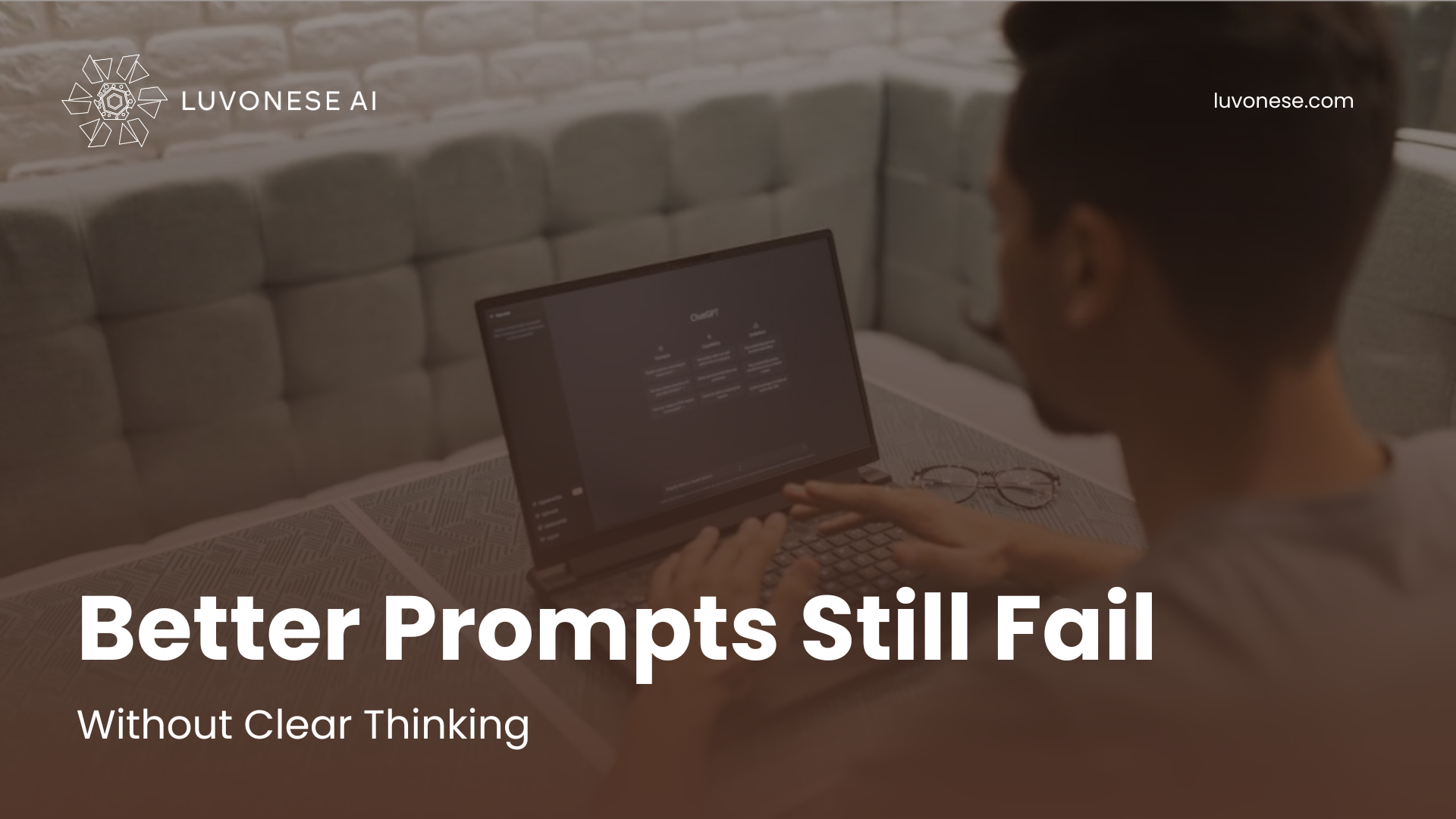
Artificial intelligence has changed how we work. With the right prompt, AI can write, analyze, summarize, and generate ideas in seconds. As a result, many people assume that better prompts automatically lead to better outcomes. But in practice, this belief often leads to frustration.
The truth is simple but uncomfortable: better prompts cannot fix unclear thinking. AI reflects the structure of our thoughts. If the thinking behind a prompt is weak, the output will be too—no matter how well the prompt is written.
The Illusion of the “Perfect Prompt”
Prompt engineering has become a popular skill. Guides, templates, and frameworks promise improved results through smarter phrasing. While these techniques help, they create an illusion that wording alone is the problem.
When results disappoint, users often tweak prompts endlessly instead of questioning their assumptions, goals, or logic. This turns prompting into a surface-level activity, focused on language rather than understanding.
AI does not create clarity. It responds to it.
Prompts Reflect Thinking, Not Intelligence
A prompt is not a command that magically produces insight. It is a reflection of how a person understands a problem. If the problem is vague, the AI response will be vague. If the goal is undefined, the output will lack direction.
This is why AI sometimes sounds confident but says very little. It is not failing—it is mirroring uncertainty back to the user in fluent language.
Clear thinking gives AI something solid to work with.
How AI Amplifies Weak Reasoning
AI is powerful because it scales quickly. That same strength becomes a weakness when thinking is flawed. Poor assumptions, unclear goals, or missing context get amplified into longer, more convincing outputs.
Instead of helping users think better, AI can accidentally reinforce shallow reasoning by producing answers that look correct. This creates a false sense of progress while real understanding stays the same.
Without clear thinking, speed becomes noise.
Intent and Context Matter More Than Words
Most failed prompts are missing intent. Users ask what they want but not why they need it. AI cannot prioritize information or reasoning without knowing the purpose behind a request.
Context is equally important. Constraints, background information, audience, and desired outcomes shape useful responses. Without these elements, AI defaults to generic answers that rarely support real decisions.
Clear intent turns AI from a content generator into a thinking assistant.
Prompt Engineering vs Thought Engineering
Prompt engineering focuses on phrasing. Thought engineering focuses on clarity.
Before writing a prompt, strong thinkers define the problem, identify constraints, and decide what success looks like. They understand the decision they are trying to support—not just the output they want to see.
When thinking is structured, prompts become simple. When thinking is unclear, prompts become complicated.
What Clear Thinking Changes in AI Output
Clear thinking improves AI results in three key ways:
First, relevance improves. AI responses align better with real needs instead of producing broad explanations.
Second, iteration decreases. Fewer back-and-forth refinements are needed because the direction is clear from the start.
Third, insight deepens. AI becomes a partner in reasoning, not just a tool for producing text.
The quality of input thinking determines the quality of output intelligence.
Practical Steps Before Writing Any Prompt
Before prompting AI, pause and ask:
-
What decision or problem am I actually trying to solve?
-
What does a good answer help me do?
-
What constraints or trade-offs exist?
-
What assumptions might be wrong?
You can even ask AI to critique your thinking before generating an answer. This shifts AI’s role from execution to evaluation.
Better thinking creates better prompts naturally.
Redefining Productivity in the AI Era
AI productivity is often measured by speed and volume. But real productivity is about clarity, alignment, and better decisions.
Better prompts alone increase output. Clear thinking improves outcomes.
In the long run, the most effective AI users are not those with the cleverest and better prompts, but those who think clearly about problems, goals, and context. AI works best when it supports structured reasoning—not when it tries to replace it.
Clear thinking remains the most valuable skill in the age of intelligent machines.