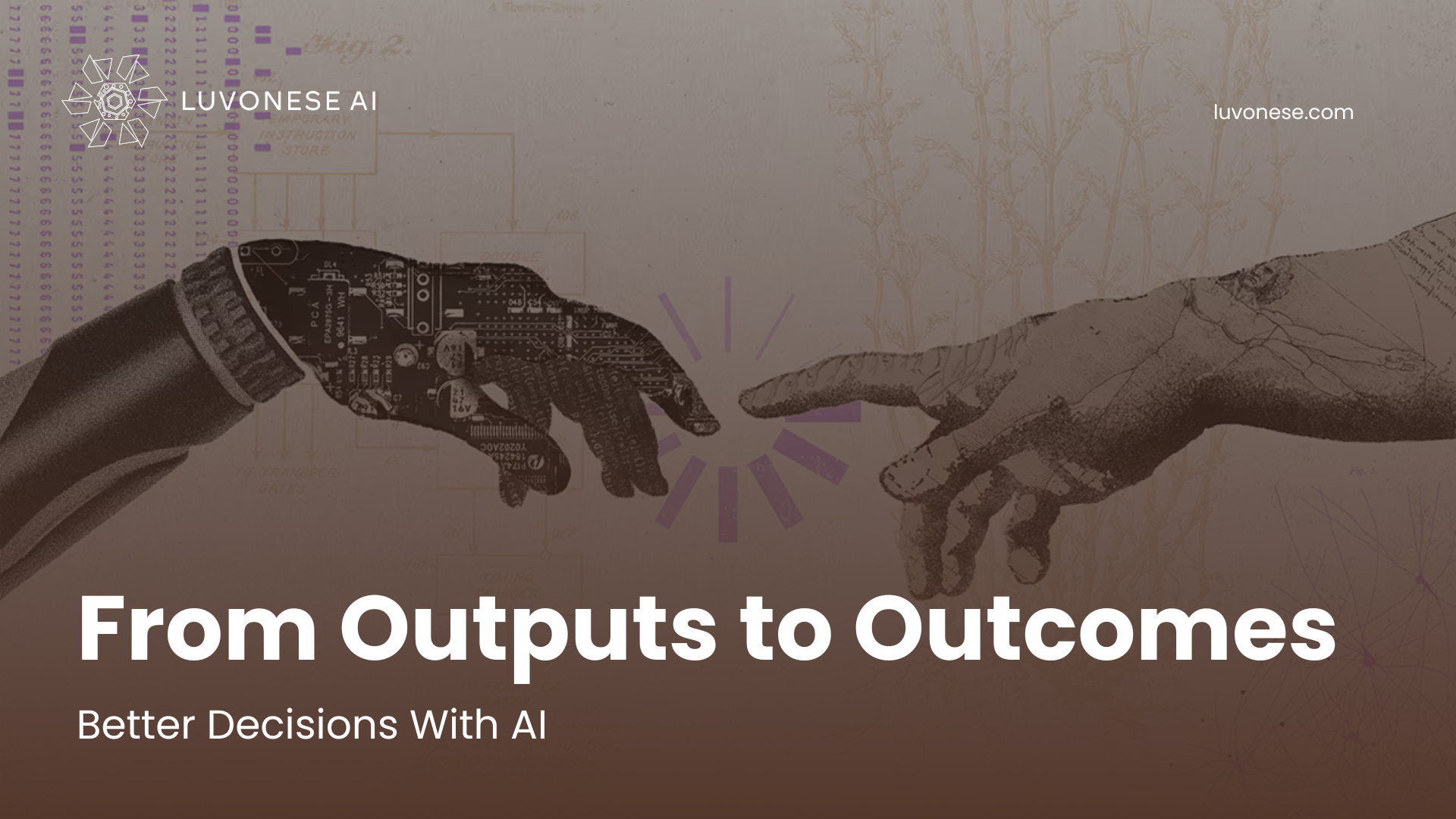
Artificial intelligence is producing more content than ever. Reports, summaries, ideas, and analyses can be generated in seconds. Yet despite this explosion of output, many teams still struggle to make better decisions. In this article we’ll break down why and how to make a better decisions with AI.
The problem is not a lack of information. It is a lack of outcomes.
Using AI effectively requires a shift in mindset—from measuring success by volume of output to measuring success by the quality of decisions AI helps us make.
The Output Trap in AI Adoption
Many organizations adopt AI with a focus on speed. Faster reports, faster writing, faster analysis. While these improvements feel productive, they often fail to change what actually matters.
Outputs are easy to measure. Outcomes are harder.
When AI is judged by how much it produces, teams risk mistaking activity for progress. The result is more documents, more dashboards, and more data—without clearer direction or better judgment.
Outputs Are Not Outcomes
An output is something AI generates. An outcome is a decision that improves results.
A summary is an output. Choosing the right strategy is an outcome. A forecast is an output. Acting at the right time is an outcome.
AI becomes valuable only when it supports outcomes. Without a clear link between output and decision, AI work remains disconnected from real impact.
More Information Doesn’t Mean Better Decisions With AI
Human attention is limited. When AI produces large volumes of content, it can increase cognitive load rather than reduce it.
Research on cognitive load shows that excess information reduces decision quality instead of improving it. AI should reduce complexity, not add to it.
External reference: https://www.apa.org/monitor/2019/01/cognitive-load
Better decisions come from relevance, not abundance.
Defining the Decision Before Using AI
The most effective AI use starts with a clear decision in mind.
Before asking AI to generate anything, it helps to answer three questions:
-
What decision am I trying to make?
-
What does a good decision change?
-
What constraints or risks matter most?
When the decision is defined first, AI outputs become focused and useful. Without this step, AI simply fills space with plausible content.
Using AI as a Decision Support System
AI works best as a decision support system, not a decision maker.
It can surface options, highlight trade-offs, challenge assumptions, and summarize evidence. But judgment still belongs to humans.
When positioned correctly, AI improves decision quality by making reasoning more explicit and structured.
From Speed to Signal
Speed is one of AI’s strengths, but speed without signal creates noise.
High-performing teams use AI to slow down the right moments—critical decisions, strategic choices, and complex trade-offs. AI helps filter information so humans can focus on what truly matters.
Signal over speed leads to better outcomes.
Designing Outcome-Driven AI Workflows
Outcome-driven AI workflows start with clarity and end with action.
Effective workflows typically include:
-
A clearly stated decision or question
-
AI-generated analysis or alternatives
-
Human evaluation and prioritization
-
A documented decision and rationale
This structure keeps AI outputs connected to real-world impact instead of becoming disposable content.
User experience research consistently shows that tools supporting decision clarity outperform tools focused on raw output.
External reference: https://www.nngroup.com/articles/ai-ux/
Measuring AI Success by Decision Quality
The ultimate measure of AI success is not how much it produces, but how well decisions improve over time.
Key signals include:
-
Faster alignment, not just faster output
-
Fewer revisions and reversals
-
Clearer reasoning behind choices
-
Increased confidence in decisions
When AI is evaluated through outcomes, its role becomes strategic rather than tactical.
Rethinking AI Value in Modern Work
AI’s true power lies in improving how people think, decide, and act.
Shifting from outputs to outcomes requires discipline. It means resisting the urge to generate more and focusing instead on what actually moves work forward.
Organizations that make this shift will find that AI does not just make work faster—it makes work smarter.