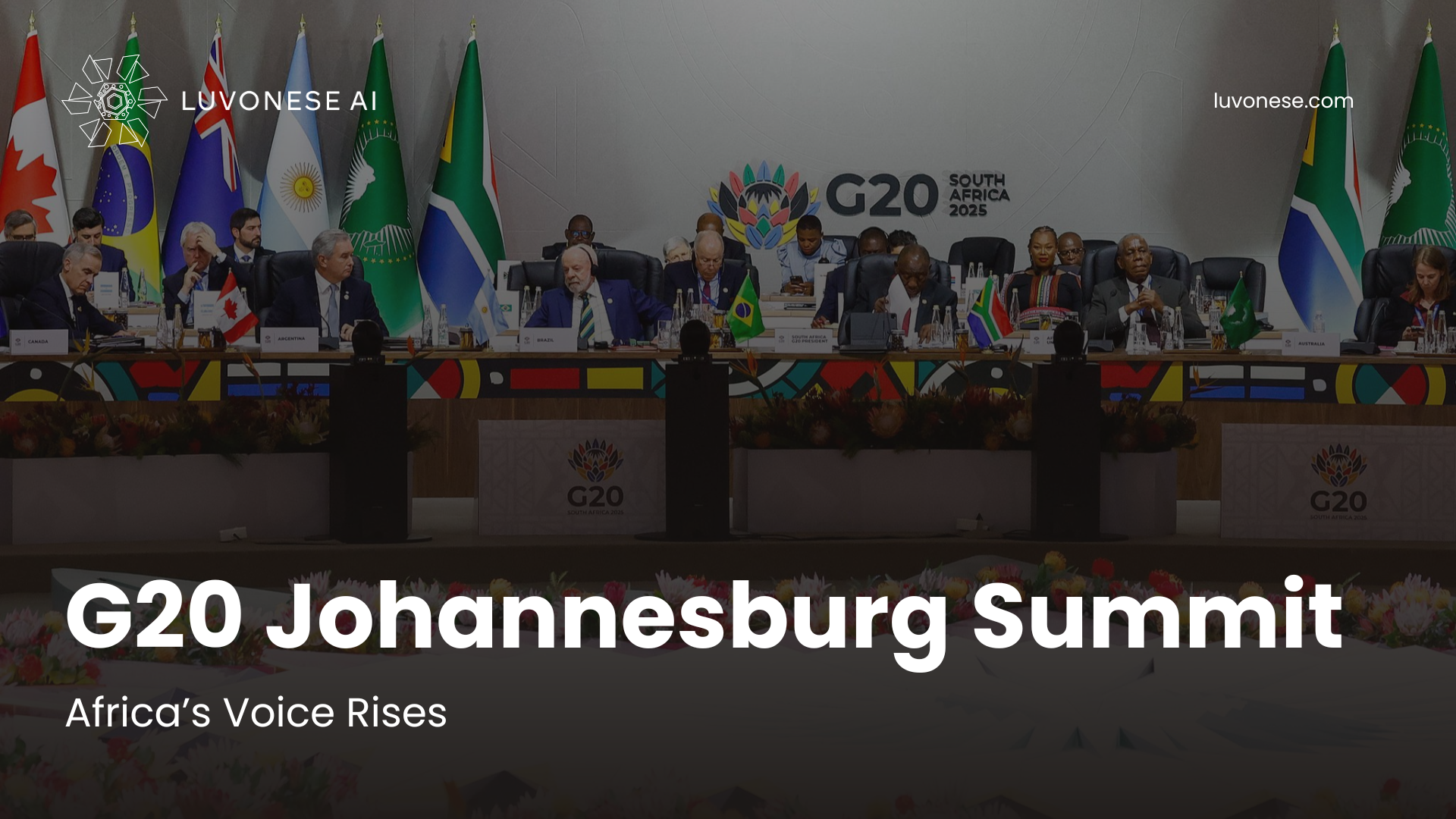
For the first time in history, the G20 leaders’ summit took place on African soil — at the Johannesburg Expo Centre in South Africa on 22–23 November 2025. Wikipedia
Branded under the theme “Solidarity, Equality, Sustainability”, the 2025 G20 Johannesburg Summit marked a symbolic and practical shift: the priorities of Africa and the wider Global South were no longer a side note — they were the headline. Wikipedia
In this article, we break down what happened in Johannesburg and why the summit matters.
A First for Africa: Why Johannesburg Matters
Hosting the G20 in Johannesburg was more than a logistical milestone. It represented a new phase in global economic diplomacy, where developing regions are not just “recipients” of policy but shapers of the agenda.
South Africa followed Indonesia, India and Brazil — the fourth consecutive G20 presidency from the Global South, another sign that emerging economies are demanding a louder voice in global decision-making. European Parliament
Theme of the Summit: Solidarity, Equality, Sustainability
South Africa chose “Solidarity, Equality, Sustainability” as the guiding theme for its presidency: Wikipedia
-
Solidarity – closer cooperation between rich and poor countries.
-
Equality – fairer opportunities between and within nations.
-
Sustainability – long-term growth that doesn’t sacrifice future generations.
These values ran through the final Johannesburg Leaders’ Declaration, a 122-paragraph document that set out commitments on debt, climate, food security, and digital transformation. G20
Who Was at the Table – and Who Was Missing
While leaders from most G20 members attended, several major powers were represented at lower level or absent. Chinese leader Xi Jinping, Russian president Vladimir Putin and US president Donald Trump all skipped the summit, with the United States boycotting the event entirely. Wikipedia
Despite this, South Africa’s President Cyril Ramaphosa succeeded in pushing through a joint declaration — a signal that the G20 can still function as a platform for cooperation, even when some of its biggest members are missing from the room. Reuters
Key Outcomes: Debt, Climate and Development
The Johannesburg Declaration emphasised a set of priorities that strongly reflect Global South concerns: TVBrics
-
Debt relief and financial reform – support for reforms to the international financial system, faster debt restructuring, and more transparent lending for low- and middle-income countries.
-
Climate resilience and energy transition – calls to scale up climate finance, invest in disaster-risk reduction, and support a just transition to clean energy.
-
Food security – commitments to stabilise food prices, support smallholder farmers and promote “Ubuntu-inspired” approaches to nutrition and price stability.
-
Inclusive industrialisation – focus on building value chains in critical minerals and green industries in Africa, not just extracting raw materials.
Africa and the Global South Take Centre Stage
One of the clearest messages from Johannesburg was the centrality of the Global South agenda. The declaration amplified calls to: Wikipedia
-
Reform global institutions like the IMF and development banks.
-
Give developing nations a stronger voice in decision-making.
-
Link climate action with development, not treat them as separate issues.
South Africa positioned the summit as a moment for Africa to move from “rule-taker” to rule-shaper in the global economy — especially on climate, debt, and the future of critical minerals.
Digital and AI: Cooperation Beyond Hardware
While the summit was dominated by debt and climate, leaders also recognised that digital transformation and AI are core to future growth. The declaration highlights:
-
The need for inclusive digital public infrastructure, so smaller businesses and citizens can actually benefit from new tools.
-
Cooperation on AI standards, data governance and cybersecurity.
-
Support for bridging the connectivity gap across developing countries.
What to Watch After Johannesburg
The summit is just a starting point. In the next 12–18 months, key things to watch include: Reuters
-
Whether climate-finance commitments turn into real money for vulnerable countries.
-
How quickly debt-relief mechanisms move for countries in distress.
-
Follow-up on digital cooperation, including AI governance and connectivity projects.
-
Whether the G20 remains unified, especially given tensions with the US boycott and geopolitical rivalries.
Conclusion
The G20 Johannesburg Summit shows how global power is gradually re-balancing. Africa and the wider Global South are no longer passive participants; they’re actively shaping the agenda on debt, climate, digital and development.