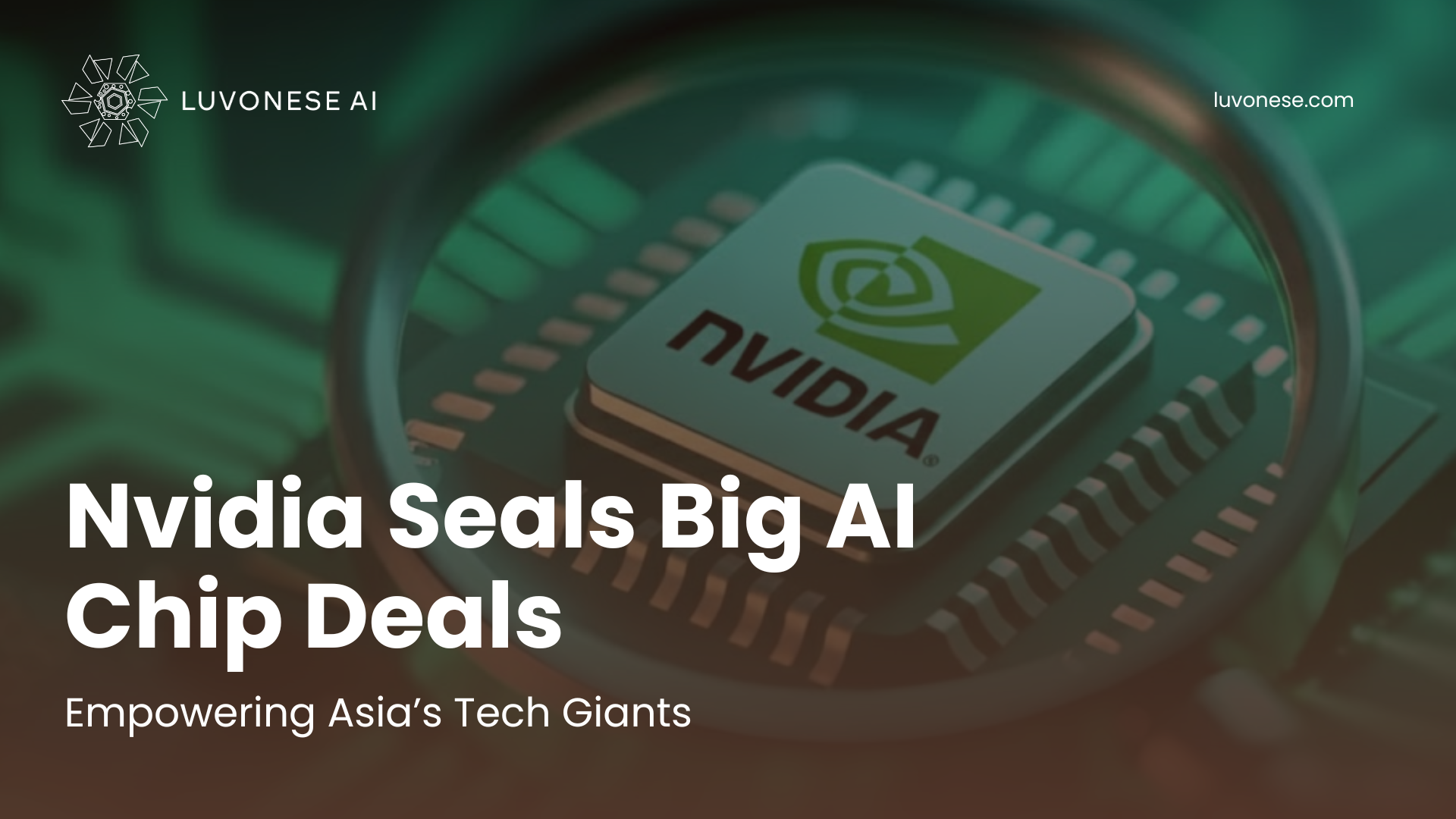
In a bold move that underscores how artificial intelligence is becoming the backbone of future industry, Nvidia Corporation has hammered out sweeping deals with major Asian technology players. At the heart of the deal is the deployment of more than 260,000 of its cutting-edge ‘Blackwell’ next-gen AI chips across both public and private sectors in South Korea. Reuters
The ripple effects for manufacturing, smart transport, data centres and even national AI strategy are significant—and this article walks through how the pieces fit together, why it matters for Asia (and the world), and what challenges lie ahead.
The Deal: What’s Being Delivered
- Nvidia will supply over 260,000 of its latest GPUs to the South Korean government and leading corporates such as Samsung Electronics, SK Group and Hyundai Motor Group. The Edge Malaysia
- Breakdown includes roughly 50,000 chips each for Samsung, SK and Hyundai’s AI-factory programmes, around 60,000 for Naver Corporation Cloud’s enterprise and sovereign-AI push, and 50,000 or more for government cloud & national AI infrastructure. Reuters
- The chips in question are Nvidia’s “Blackwell” architecture design—optimised for next-gen AI workloads. Reuters
Why It Matters: Strategy & Spectrum
Industrialising AI
For nations and companies alike, AI is no longer about chatbots and image-generation only—it’s about embedding intelligence throughout heavy manufacturing, supply chains, smart factories, autonomous vehicles and robotics. South Korea, with its historic strength in electronics, semiconductors and auto manufacturing, is positioning itself as an AI-industrial hub.
Nvidia CEO Jensen Huang put it succinctly: “just as Korea’s physical factories have inspired the world … the nation can now produce intelligence as a new export.” Reuters
Diversification away from China-only growth
Amid U.S.–China export controls, especially on advanced AI chips, Nvidia is pivoting deeper into other Asian markets. This deal speaks to an Asia-focused strategy that doesn’t solely depend on China. Reuters+1
National and corporate convergence
This isn’t just a corporate purchase. The mix of government, cloud providers, automobile industry and semiconductors means that AI infrastructure is becoming a strategic national asset—comparable to power grids or telecom networks. Nvidia’s own release calls this “sovereign AI infrastructure”. The Edge Malaysia
Implications for South Korea and Asia
Boosting Korea’s global AI footprint
With the deployment of these chips, South Korea could elevate its standing from being a manufacturing powerhouse to a top-tier AI ecosystem. The infrastructure will underpin national foundation models, smart mobility and the next wave of tech exports. CNA
For Asia’s tech ecosystem
Other Asian nations will watch closely. Partnerships like this raise the bar for regional competitiveness, push global supply‐chains, raise expectations for AI localisation and may trigger accelerated investments in fellow regional champions (e.g., Japan, Taiwan, Singapore).
Corporate transformation
- Samsung aims to embed AI across its semiconductor and electronics value‐chain—from design to fab operations. Fast Company
- Hyundai is accelerating “physical AI”—using Nvidia’s tech for autonomous driving, smart factories and mobility services. TechCrunch
- SK Group will use the infrastructure to build an “industrial AI cloud” for Korea’s manufacturing ecosystem. The Edge Malaysia
What It Means for Nvidia
This large-scale deal strengthens Nvidia’s leadership in AI hardware. It validates its Blackwell architecture and gives it a foothold in an important market.
It also reinforces the company’s shift from gaming-GPU into enterprise, industrial and sovereign-scale AI datacentre sales. The ripple to Nvidia’s business model is that this is no longer niche—it’s foundational infrastructure.
Challenges and Risks
Export controls & geopolitics
Nvidia still faces restrictions in China, and whether Blackwell chips can be sold into that market remains uncertain. Reuters
Supply-chain and manufacturing pressures
Fulfilling 260,000+ advanced-GPU orders means Nvidia needs strong manufacturing, logistics, and coordination across global supply chains—any hiccup could delay deployments.
ROI and scaling for customers
For the corporate partners, embedding AI at scale across manufacturing and mobility is complex. The hardware is only the first piece—software, talent, data-governance, model deployment all need alignment for full value.
Competitive landscape
Other hardware players, AI-chip startups, cloud providers and national programmes (e.g., China, India) are not standing still. Nvidia must ensure it remains ahead both technologically and strategically.
Broader View: AI Infrastructure as Critical Backbone
What this deal illustrates is a wider trend: that AI is becoming as critical as energy or telecommunications infrastructure. Nations want the compute capacity; companies want the agility; chip-makers must deliver the performance.
For Asia, this is a seminal moment. The region is moving from being the “factory for the world” to the “intelligence factory for the world.” Nvidia’s chips powering Korea’s smart factories, mobility systems and cloud infrastructure is symbolic of that shift.
Takeaway
If you’re in the business of AI (whether as a developer, investor, enterprise decision-maker or infrastructure strategist) this deal signals three clear things:
- Compute availability is scaling: Tens of thousands of advanced AI chips are moving into production infrastructure—not just pilot environments.
- Asia is a serious battleground (and beneficiary): Countries like South Korea are doubling down on AI infrastructure and leveraging global technology partnerships.
- Hardware is no longer just “nice to have”: It’s becoming a strategic axis around which business models, national policies, corporate alliances and global value chains are organized.