
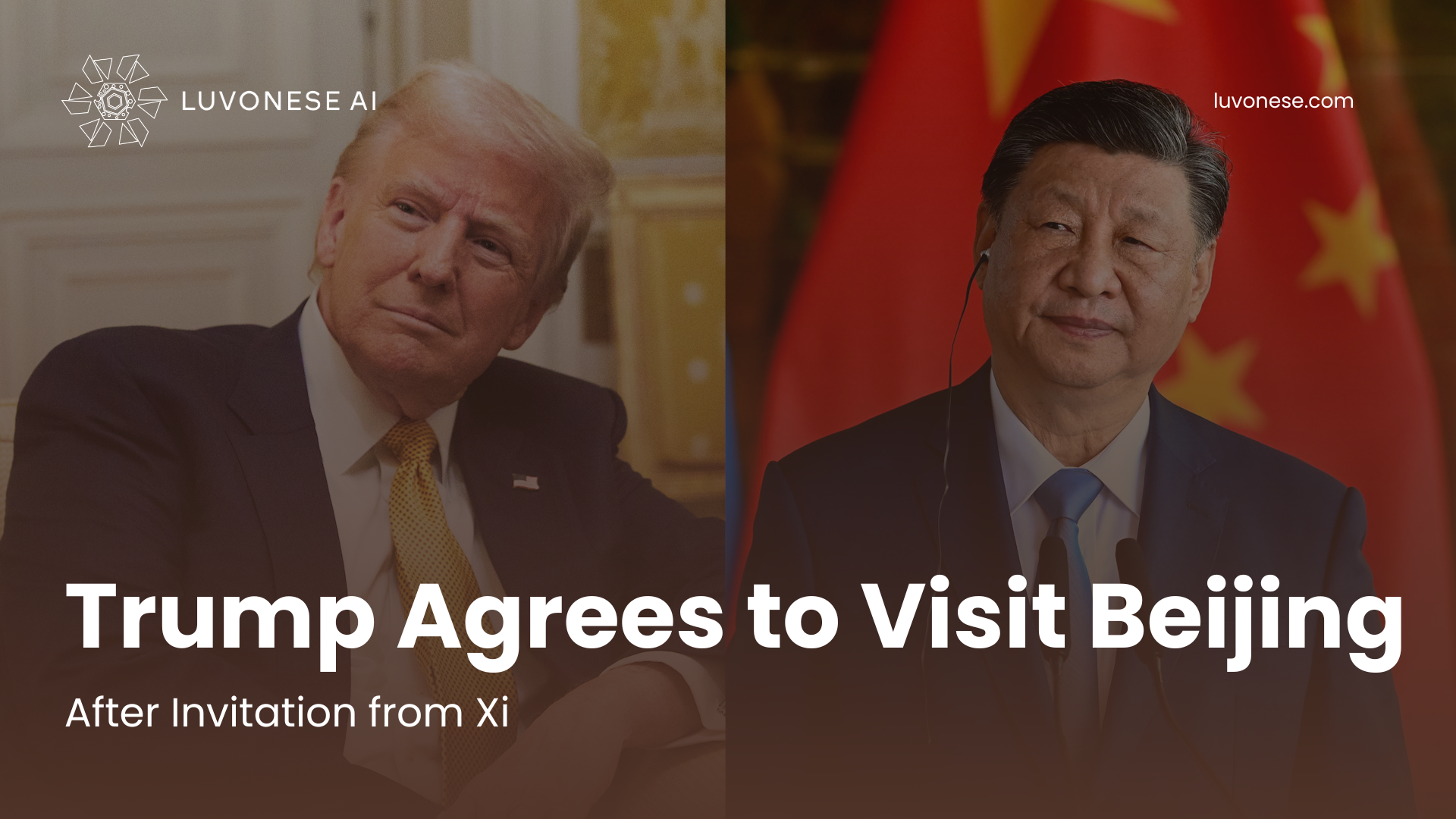
Donald J. Trump agrees to visit Beijing in April 2026 after a formal invitation from Chinese President Xi Jinping. The upcoming trip is already being framed as one of the most consequential diplomatic events of the year. As tensions between the United States and China continue to shape global politics, the prospect of Trump and Xi sitting down face-to-face carries implications that extend far beyond bilateral ties.
This will mark Trump’s first return to China in nearly a decade and could become a defining moment for the future trajectory of U.S.–China relations.
A Carefully Timed Diplomatic Exchange
According to officials familiar with the planning process, Xi Jinping extended the invitation during diplomatic exchanges aimed at reopening stable communication channels between Washington and Beijing. Trump accepted shortly after, calling the visit “an important step toward clarity and dialogue.”
The visit is tentatively scheduled for April 2026, though the final program, meeting structure and press format are still under negotiation. While concrete agreements are not guaranteed, the symbolism of the invitation alone signals a shift in tone after years of strained relations.
What Motivated the Invitation?
Beijing’s decision to invite Trump reflects several strategic considerations:
1. Stabilizing a volatile relationship
U.S.–China relations have been marked by tariffs, military tensions, sanctions and competing technology ambitions. A high-level meeting provides a platform to reduce miscalculation.
2. Managing global economic uncertainty
Both economies face pressure from inflation, trade fragmentation and disrupted supply chains. Dialogue helps mitigate market instability.
3. Demonstrating openness to diplomacy
Xi’s invitation underscores China’s message that it is willing to engage directly, even amid rivalry.
What Trump Hopes to Achieve
The Beijing visit could support several goals for Trump:
-
Reasserting his diplomatic influence on the world stage
-
Highlighting negotiation credentials that defined much of his previous foreign policy
-
Seeking new economic openings or tariff adjustments
-
Clarifying positions on technology restrictions and trade barriers
While Trump is known for unconventional diplomacy, analysts expect him to pursue a mix of symbolic gestures and tough negotiations.
Key Issues Likely to Dominate the Agenda
Although the official agenda has not yet been released, multiple areas of friction are expected to be front and center.
Trade and Tariffs
The U.S.–China trade dispute remains unresolved. Both sides still maintain extensive tariffs on hundreds of billions of dollars in goods.
The Beijing meeting could explore:
-
Limited tariff rollbacks
-
New agricultural or manufacturing agreements
-
Mechanisms for more predictable trade policy
Businesses in both countries will be watching closely for signs of de-escalation.
Technology and AI Restrictions
Technology is the most sensitive and competitive domain in the relationship. Expect discussions around:
-
AI safety and governance
-
Semiconductor export controls
-
5G and digital infrastructure security
-
Rare-earth mineral access
-
Restrictions on U.S. cloud services in China and vice versa
Neither side is likely to make major concessions, but guardrails could be introduced to prevent deeper escalation.
Military and Security Concerns
The South China Sea, Taiwan, and cyber operations remain flashpoints. A key objective will be establishing:
-
Crisis communication channels
-
More frequent military-to-military dialogue
-
Clearer boundaries to avoid unintentional conflict
Even modest steps in this area could be seen as progress.
Symbolism: Why the Visit Matters Beyond Policy
Presidential visits between major global rivals often carry heavy symbolic weight. Images of Trump and Xi standing together in Beijing will shape international perception even if negotiations yield limited policy changes.
For China, hosting Trump reaffirms its status as a critical global power.
For Trump, the visit reinforces his argument that he can “talk to anyone” and manage complex great-power rivalries.
Diplomacy is often defined not by dramatic breakthroughs but by the maintenance of dialogue — and this visit serves that purpose.
International Reactions and Global Stakes
U.S. allies in Asia and Europe will closely monitor the Beijing meeting:
-
Japan and South Korea will watch for shifts in security commitments.
-
Australia and Southeast Asian nations will analyze how the meeting affects regional stability.
-
European partners will look for clues about future technological and trade alignments.
Meanwhile, rivals — such as Russia and Iran — will interpret the meeting as a potential recalibration of global power relations.
Markets, too, will respond. Historically, even the announcement of high-level U.S.–China dialogue influences equities, currency markets and commodity prices.
What a Successful Visit Could Look Like
A sweeping diplomatic breakthrough is unlikely. Instead, success will probably be measured in incremental achievements, such as:
-
Agreements to maintain regular communication
-
Clear statements on managing competition responsibly
-
Working groups on trade, technology or climate
-
Reopening suspended diplomatic or military channels
The goal may not be harmony, but stability.
Conclusion: A Meeting That Will Shape 2026
Trump’s acceptance of Xi Jinping’s invitation to visit Beijing in April 2026 sets the stage for one of the year’s most significant diplomatic moments. Whether it leads to de-escalation, strategic clarity or renewed rivalry, the world will be watching closely.
In a time defined by geopolitical uncertainty, the simple act of two leaders choosing to meet face-to-face is itself a meaningful development — one that could influence global politics, economics and security throughout 2026 and beyond.